Fairy Tale Nook
Welcome to the:
"As both writer and illustrator, Bardow (The Whispers of the Heather) fills this collection with the wonder and urgency of classic fairy tales while highlighting ingenuity and courage. These strong heroines and charming heroes face a host of conflicts that combine magical elements with problem-solving quests, and parents who enjoy the nostalgic quality of fairy tales—but don’t want to perpetuate stereotypes like the damsel in distress—will appreciate Bardow’s earnest approach. Digital illustrations recreate haunting forest scenes amid high castle walls, and Bardow’s focus on individual growth as much as spellbinding magic creates a fairy tale collection that celebrates strong characters who find a way to save themselves."
BookLife Reviews
Here, every first of the month, I will be posting a select story from my new book:
The Tales Of The Old Hut
Select fairytale stories for your reading enjoyment
Scroll down to see and read the latest story from
The Fairy Tale Nook
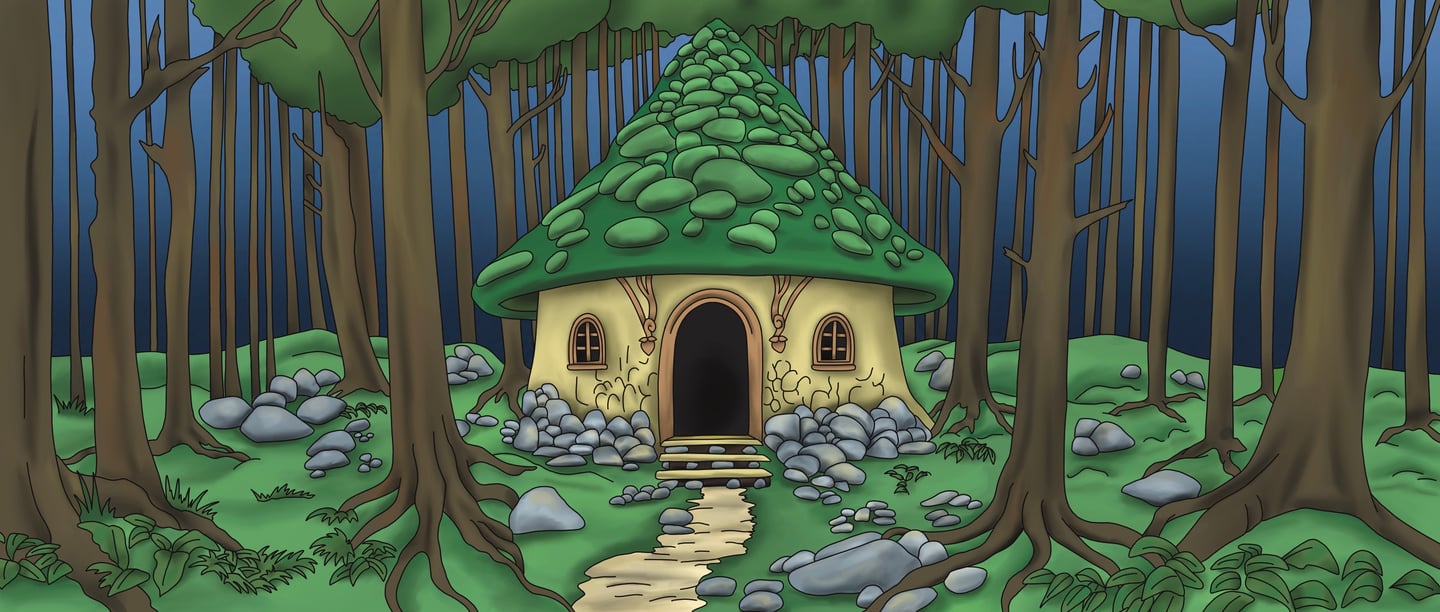
They say there is a mystic wood somewhere,
Where magic and enchantment fill the air.
The twilight reins under the ancient oaks.
Dark lichens cover knotted bark and rocks.
The silence is complete, no sound is heard:
The murmur of a spring, the chirping of a bird.
Green moss is thick and muffles every stride.
So, please, be watchful: it will try to hide,
A path that leads to an abandoned hut.
If you step in, the olden walls will start,
Tell fairy tales. Not one, not two, but more,
Charmed stories that were never heard before.
But would you dare to come to this bewitching place?
And if you would, a dreamlike realm awaits!
Olwen Bardow
© 2025
This month's story:
Previous stories:


(Stories to be continued...)
The Tale of the Groom's Image
It happened in times long ago. During a cold winter, in a small village, on long dark evenings, the local maidens would gather in the spacious room of one of their houses, so as not to be bored. They would spin, embroider, sing songs, joke with each other, and also tell various interesting stories.
On one such a jolly evening the conversation turned to their future husbands.
“You know,” said one of the maidens, “It’s going to be a full moon in three days. They say that at this particular time there is a way to see what your future suitor will look like!”
“Tell us more!” exclaimed the rest of the company. “How can we do it?”
“Ah, I don’t know,” replied in confusion the one who had stirred up this interest in the others. “But old Tilda, who lives in the forest in the hollow near the waterfall, knows all about this for sure!”
The maidens fell silent. They knew old Tilda the hermit and were slightly afraid of her. Neither of them would have dared to go to her secluded house with such a question. But among the fair gathering was one exception — brave Elsa. She decided that old Tilda wouldn’t scare her, and that she will find out for sure how to look into the future to see her betrothed on the coming full moon.
Her plan was that much easier to implement because all of Elsa’s household was planning a trip to their relatives in a neighboring village for a whole week to celebrate the name day of the oldest grandfather of the whole family. Elsa excused herself from this visit by saying that she had a slight cold and thus did not go with the others.
Instead, she baked some crispy pies, filled a deep bowl with fresh cottage cheese, all as a gift for old Tilda so as not to come to her empty-handed; and then went into the forest, to the lonely house, hidden under the snow drifts in a hollow near a frozen waterfall.
Old Tilda greeted Elsa warmly and invited her visitor into the house. Up close she turned out not to be so scary after all. In Tilda’s dwelling, the hearth was heated hot, whole bunches of fragrant dry forest herbs were hung from the ceiling, and on the bench lay a curious cat, with fur that was black as night.
Elsa told old Tilda about the purpose of her visit and asked the old woman to teach her how to gaze at her future betrothed, because she was very interested in what he looked like. Old Tilda began to dissuade her, saying that it was dangerous, but Elsa was stubborn and began to assure the hermitess that she was brave and would not be scared at all.
“All right,” said old Tilda finally, “I will teach you a way to do this on one condition, that you be the host for my black cat and take care of him for three days!”
Elsa was surprised by such a request from old Tilda, but thought that the old woman, too, probably, decided to visit her relatives or friends, and did not want to leave the cat bored in her house alone. So, Elsa agreed.
“Listen then,” said old Tilda conspiratorially. “Find something hard and sharp in your house that you can scratch on the ice with. On the night of the full moon, go out to the ice hole in the river. Scratch a full circle on the ice, next to the ice hole, then stand in the center of this circle and say the following:
“The moon in the sky high above me,
The moon on the ice that is drawn,
And right in the water, my betrothed is shown!”
“Then look carefully into the ice hole. There, under the surface of the water, will appear a vision of your future match, like in a dark mirror. It will be a water spirit, that will take on his appearance but remember: and don’t forget, immediately after you see the vision, say the following words:
“Don’t get out! Do stay there! Do remain in the depths!” otherwise, big trouble will happen!”
Elsa thanked old Tilda, placed the black cat in the basket in which she had brought the cottage cheese and pies, and returned home.
There she thought everything over for a while. Though involuntary chills of fear began to run down her back, she still decided to go ahead with her plan. She imagined how her friends would envy her when she told them that she had managed to see her betrothed, besides, she was truly curious herself, what would he look like!
The cat behaved very politely. He drank a full saucer of milk poured for him by Elsa, and then climbed under the bench and hid, acting as if he was not there at all.
The night of the full moon was clear, frosty, and very quiet: not a dog barked in the village, not a shutter creaked. The snow was as white as a wedding dress. Elsa slipped out of the house around midnight with an iron nail in her pocket that she found in the attic. She thought it would be perfect to scratch the circle on the ice, as old Tilda had taught her.
Elsa hurried to the river. She was only worried that the hole in the ice might freeze. But the water there was not covered with a crust of ice; indeed, it sparkled in the moonlight like a black mirror. There was not a soul around, only the moon in the sky seemed to be watching Elsa, as to what she intended to do.
Elsa knelt down and with the iron nail, scratched a circle on the ice near the hole. Then she stepped right into the center of the mark she had made and said in a confident, albeit slightly trembling voice:
“The moon in the sky high above me,
The moon on the ice that is drawn,
And right in the water, my betrothed is shown!”
Then she began to wait, not taking her eyes off the water in the hole. Nothing seemed to be happening. The frost finally began to pinch Elsa, which made her shift from foot to foot. She briefly glanced at the moon, whose disc shone with the purest silver, but when the maiden looked down into the hole again, she jumped in surprise. From there, a pale face was looking at her, appearing near the very surface, as if a drowned man had come up from the bottom of the river.
Brave Elsa got scared to death and was so startled that she forgot to say the words that would end the ritual:
“Don’t get out! Do stay there! Do remain in the depths!”
Meanwhile, the stranger who had appeared in the ice hole already raised his head above the water and was already grabbing the edge of the ice, intending to climb out. His empty eyes shone like silver moons.
“Come to me, my desired one,” he croaked. “Let us rest together at the bottom of the river! Was it in vain that you called me?”


Elsa’s throat was so constricted with horror that she could not even let out a scream, but her legs did not fail her. She rushed away from the river with all her might. Where did her agility come from? In the meantime, her sweet “betrothed” had already climbed out of the ice hole up to his waist. Oh, how Elsa ran that night, faster than an arrow shot from a bow! Very heavy steps followed her, but she did not dare to look back. She sensed that a black shadow was catching up to her.
Elsa rushed into her house. Hardly had she managed to slam the door and tightly slide the bolt, as it shook from a terrible blow, and the same sepulchral voice was heard:
“Where have you run off to, my desired one, open the door for me! Open the window!”
And indeed, after that, there was a knock on the window, which fortunately had its shutters closed. Water began to leak under the door. The house was silent and as dark as a crypt. With trembling hands, Elsa lit a candle, but the flame immediately went out. To add to her horror, the light continued to be seen burning in a small mirror hanging on the wall.
Then a dark hand stuck out of the mirror surface, along with the ghostly candle, and a whistling whisper was heard:
“It is not good, oh maiden, to greet your betrothed in such a way! He does not like the living fire. I am the looking glass spirit, and I give you the fire that does not burn. Take it and open the door quickly to your darling. Meet him! Welcome him. He followed your invitation.”
Now Elsa’s voice came back, and she screamed so loudly that she almost went deaf herself. This was the moment when old Tilda’s black cat jumped out from under the bench. He ran around the room of the house three times, scattering fiery sparks from his fur. After that, the knocking on the door stopped, and the hand with the ghostly candle protruding from the mirror vanished. Silence and peace came.


In the morning, it turned out that the door could not be opened. Elsa climbed out through the window and saw that a whole lake of frozen water had filled up around the house, and the door was doused with water from the outside and was covered in ice.
Elsa worked for a long time, swinging an axe taken from the barn to chop off the ice. The fiery sparks that old Tilda’s black cat had sprinkled from his fur the night before had burned through the floorboards in the house. But fortunately, there was no sign of Elsa’s “betrothed” around.
Then Elsa took the black cat that had saved her back to old Tilda. Old Tilda was at home and looked inquisitively at Elsa and asked:
“Well?”
Elsa told her everything. Old Tilda shook her head while listening to the story and then explained:
“In winter, the water spirit sleeps peacefully at the bottom of the river. The ritual wakes him up from his slumber, then he takes on the appearance of the future betrothed of the one who summoned him, and shows up in the ice hole. That’s why it is important to say the words of release. Then the water spirit will return to doze at the bottom of the river again, without remembering that he had been once awakened. If the proper words are not said, then the water spirit will fully wake up and will be angry that he was roused up for nothing. Then the daring maiden who is performing the ritual will be dragged by him into the water.
“You are lucky that you managed to run home. As for the mirror spirit, he decided to help his cousin from the river, for they both belong to the same world of the undead. You see, the mirror also reflects everything on its surface, as does the water, only much clearer.
“The mirror spirit has since calmed down, and will not bother you again, but do be careful from now on around the river. The water spirit has taken a dislike to you from that day, and will take revenge,” old Tilda warned the upset maiden.
“Will he drown me, probably?” Elsa sadly assumed.
“Drown or not drown, but he will send stinging mosquitoes at you on the bank of the river in the summer evening, and if you go fishing, you won’t catch a single fish. Also, if you go to rinse your laundry in the stream, he will smear it all with river mud. But you are alive now and escaped danger. All’s well that ends well,” old Tilda finished her speech.
Elsa listened sadly to the old woman’s story, sighed, and responded:
“I want to thank you, old Tilda. Your cat saved me, and I saw my betrothed. But I will never marry him now. He seemed so scary to me, that I am still shuddering.”
“Oh, dear me,” sighed old Tilda in turn. “Go wash your face by my waterfall, maybe you’ll feel better!” said she to the maiden.
Elsa came out of old Tilda’s house and saw that cheerful drops were dripping from the frozen waterfall because the midday sun had melted the ice. She washed her face with the icy water and after that, truly felt better.
Then Elsa returned home. Shortly afterwards, her family arrived. Oh, how unpleasantly surprised were they to see a frozen lake of water surrounding the house, and they got even more angry and upset when they saw the burnt-through floorboards. They scolded Elsa for a long time, and tried to find out from her what kind of devastation had befallen the dwelling in their absence. But Elsa did not admit to anything and kept silent despite all the questions.
Winter passed, summer came. Elsa tried not to go near the river, so as not to disturb the water spirit. But something good happened too. She met her true, flesh and blood betrothed, in the crowd at a noisy fair held on the occasion of the first summer harvest, and recognized him right away in the crowd. Was it for naught that she had gazed at his appearance in the ice hole in winter?
The young man looked at Elsa, smiled, and greeted her. He turned out to be a farmer from a distant village. And what do you think, Elsa married him after all, because her fear of him had dissipated: her true betrothed’s eyes were not empty silvery disks, but warm, alive, and human.
(Posted September 1, 2026) © 2025


(Stories to be continued...)
The Song in the Night
It happened many, many years ago. In those days there lived a baron who had a son by the name of Conrad, his pride and consolation, the future heir to the ancestral castle and the baronial honor of his family. One day, this young baron, who had just reached the age for competing in jousting tournaments, went out onto the platform of the watchtower of his castle at night.
He was wide awake. After fruitless attempts to doze off, he decided to check the guards. It was not in vain, for the guards were immersed in a deep sleep which had never happened to them before. It was then that young Baron Conrad suddenly heard a song in the night. A bird sang, melodiously and loudly, as if playing a flute. There was no threat in the song, but for some reason, a chill ran down the young baron’s spine, and his heart began to beat with an ominous premonition.
The next morning, he told his father that he had heard a strange song of an unseen bird in the darkness of the night, and the old baron grew anxious upon hearing this.
“Alas!” he said, “this singing does not bring anything good, but it is a harbinger of sorrows and troubles for the one who heard it!
“It was a long time ago,” continued he, “back in the reign of our king’s great-grandfather, who suddenly became infatuated with the youngest daughter of one of his vassals, a simple baron. They say the maiden was really beautiful, and her name was a strange one in our lands: Oisellan.
“Oisellan was already engaged to a brave knight from around the area, but misfortune befell her fiancé. Someone dealt with him cruelly on a lonely road among the hills, while he was riding there after sunset returning to his castle. They said even more: everyone was simply sure that it was the king, who with the help of a gang of hired cutthroats, eliminated his rival, and then asked for the maiden’s hand in marriage.
“Her family didn’t dare reject the king’s proposal and began to prepare for the wedding, but Oisellan kept going to the grave of her fiancé, shedding bitter tears there. Eventually reeds grew on this grave, so Oisellan cut one reed and made a flute out of it. The flute sang bitterly and sadly, and Oisellan played on it all day long, or else she shed tears inconsolably. But eventually her relatives began to frown upon that, and told Oisellan to wipe her tears away, accept the royal gifts, throw the dead fiancé out of her mind, and prepare to become the queen. Finally, they locked her in the castle so that she would not be able to go to the grave of her beloved anymore.
“Oisellan agreed to their terms, and promised that she would do everything they said, only asked to let her go for the very last time to say goodbye to her perished loved one, otherwise, she would say “no” to the king at the altar and disgrace them all. She had a strong character, and her relatives knew that she would do just that. Therefore, they let her go to the grave to say her last goodbyes.
“She took the flute along with her and left. One of her brothers was sent after her to make sure that Oisellan did not run away, and he told the following story: Oisellan bent over the grave and then disappeared, while a small bird flew up into the sky. Thus, she never returned.
“The cruel king never got her as a wife. But since then, Oisellan, who became a bird, warns the one listening to her song in the night that misfortunes await. So, it is not good that you heard her song, my son!”
Shortly after, a messenger brought the old baron the king’s summons to appear before him with all the baron’s faithful servants and his son. The old baron plunged into thought. Although the invitation seemed friendly, a shadow fell on his heart. The king was treacherous and cunning. Who knew what was in his mind? Still, the baron could not refuse the assiduous invitation, for it came from the ruler of the lands.
The old baron rode out to the royal court, but in the middle of the dark forest, he stopped his cortege, took his son Conrad aside, and ordered him to hide in the thicket.
“Stay here!” the old baron ordered. “I cannot disobey the king’s summons and not appear before him, otherwise, I will be declared a traitor. But our king is sly and can set a trap for me and all of us. Remain in the thicket and wait for a faithful man to come for you. If he comes and says that everything is fine, then show up at the royal castle. But if he does not appear in three days, then trouble has happened, and the song in the night did not lie. Then run. That’s my order!”
The young Baron Conrad remained in the forest. He did not have to wait for three days. Towards the end of the second day, a horseman, one of the old baron’s servants, appeared in the forest and began calling loudly for Conrad. But the young baron sensed something was wrong. The messenger called his name too cheerfully, and looked around too meticulously.
Conrad attacked him, knocked him off his horse, pinned the messenger to the ground, put a dagger to his throat, and learned the terrible truth. His father was executed immediately upon arrival at the king’s castle, and all his devoted servants and vassals along with him, unless they swore to serve the king faithfully from now on. The king was angry when he learned that the baron’s son had been left in the forest and ordered that he be brought to the royal castle so that he could suffer the same fate as his father. Then the old baron’s former servant, who had sworn allegiance to the monarch and thus saved his life, volunteered to bring young Conrad to court for a good reward. Conrad also learned that the king had already sent troops to occupy his ancestral castle. Having dealt with the traitor, the young baron fled into the forest thicket and swore revenge.
“Truly the song in the night predicted the trouble,” thought Conrad, “Oisellan, Oisellan, your voice brought me grief!”
So that his ancestral castle would not fall into the hands of the treacherous king, Conrad burned it to the ground, and then raised a rebellion against the tyrant. He spent many years in battles and hardships, being an outlaw, suffering need and hunger, dealing with defeats and losses.
The thickets of the forests and the lonely gorges were his refuge from now on. His hearing became sharp as a wolf’s, and his sight piercing, like a falcon’s. Snowstorms pelted Conrad, and the heat of the sun scorched him.
But again and again, he gathered armies of dissatisfied vassals after the defeats to overthrow the vile king. And at last it happened. Luck was on Conrad’s side. In the final battle, Conrad, with the fury of a beast, rushed at the barrier of knights protecting the monarch, overthrew them all, and chopped off the king’s head. The power of the despot was over.


When the rejoicing rebel camp had quieted down, Conrad was still sitting by the night campfire. Now that it was all over, he was overcome by fatigue. He remembered his burnt castle, where his ancestors had lived for generations. Now it would be necessary to rebuild it. All flashed through his mind: the fallen comrades, wounds, betrayals, close escapes, pursuit after pursuit, when he was hunted like a wild animal.
Everything was behind now, and Conrad shuddered, his heart ached, when he again heard a clear song in the night. He could not be mistaken, a ringy bird’s voice sang, as if playing a reed flute. Oisellan was warning him of danger again.
“What trouble are you singing about and predicting for me yet once more, oh bird of the night?” Conrad whispered. “I have no more strength left in me to fight.”
And in the morning, he was brought a golden crown. He was a fearless leader, and now he was unanimously elected among the barons of the land to be their king.
Hard days dragged on, when it was necessary to restore the ruined kingdom. Conrad spent most of his time in the saddle, remaining without sleep for days, riding around his lands. He built fortresses, strengthened castles, resolved disputes between barons, suppressed the disobedient, and uncovered conspiracies against the crown. It was very heavy, this crown, and the royal power was a burden, but in the end, things began to improve. The rebuilt citadels provided good protection, the lands brought a good harvest, passions subsided, and prosperity and peace descended upon the kingdom.
One night, King Conrad could not sleep. He opened the window in the royal bedchamber.
“Well, here I am,” he thought, “who would know—the monarch, and I never dreamed of it, and truly never wanted it. Why did fate choose me as king?”
Then a chill ran down his spine because he heard the melodic singing in the night. Loudly and boldly, a bird sang in the darkness, purer than the clear sound of a flute. Conrad could not help but recognize the voice.
“What other bad things are you predicting for me?” Conrad clenched his teeth. “What other troubles do you foretell?”
The next day, the war began. A neighboring kingdom, aware of the discord that had tormented King Conrad’s domain until recently, attacked his lands, wanting to enslave him and his subjects. But Conrad was a good military leader. Years of battles and struggles had tempered him. He confidently led his army and was merciless in battle. The disgraced enemy left his domain, vowing never to go against the Iron King Conrad again.
At last peace came to the kingdom. Life became quiet and calm, only King Conrad carefully avoided going out anywhere at night, and tightly closed the shutters on the windows of his bedchamber when darkness reigned.
One day, though, sleep would not come to him yet again, and he broke his habit, by going out to the tower of his castle to check on the guards. And not in vain. The warriors there slept as if they were dead. No matter how hard King Conrad tried to wake them, his attempts were fruitless.
“What am I doing?” Conrad thought anxiously. “I must leave this place. I do not wish to hear the song in the night ever again!”
As soon as he thought of this, a small bird landed on the edge of the battlement. The wall was illuminated by the full moon, but the bird was as dark as the night’s sky above Conrad’s head.
“So, was it you who sang in the night?” Conrad asked bitterly. “Have you come to sing for me once more?”
The bird did not give a chirp in reply, only dropped a silver tear from her eye, which rolled with a thud to Conrad’s feet, shining in the night.
“Weep, weep!” Conrad encouraged her. “The scars covering my body hurt hard, and the scars on my heart hurt even harder!”
He bent down and picked up the tiny tear. At that moment, the pain in his body subsided. The bitterness in his soul also lessened. Conrad raised his head and saw that the bird had disappeared, but a transparent, barely noticeable ghost of a maiden now stood before him.
The maiden was wearing simple clothes of an olden fashion, a thick braid was thrown over her shoulder from her back to her chest. In her hands, she held a thin flute.


“Forewarned is forearmed!” she whispered in a voice like a rustling breeze.
“Would it have been better for you to die at the whim of a tyrant? Did he deserve to rule the lands if he executed the barons, his subjects, without trial, just at his will?
“Do not these much-suffered lands deserve a good king?” continued she, “The previous vile monarch would have weakened the whole domain, and the neighboring king would have easily conquered it. Then all the subjects of this kingdom would have become slaves. But you are just, you are a good ruler, you have won freedom for your own lands, and placed a foundation for their prosperity. Is that bad?”
“You are truly a sweet-voiced bird,” said Conrad. “I am simply mortally tired! But I will say one thing, that as king, I will never force any maiden to marry me. If I take a wife, then only if she reciprocates my feelings.”
“I know, Conrad, I know,” responded the shadow of Oisellan. “That is why I warned you of the impending danger. The great-grandson of the overlord who killed my beloved, the vile opressor himself, is defeated. Troubles pass, better times always come after them.”
At that moment, a falling star flashed across the sky, scattering into myriads of fragments, and falling into the valley beyond the forest.
“A baron who was always loyal to you lives in a castle there,” continued Oisellan. “He has three daughters. A fragment of a star fell right on the baron’s courtyard and adorned the temple of one of them. Woo her, King Conrad, and then true happiness will enter your life.”
“And what about you, oh night bird, Oisellan,” asked Conrad, “will better times ever be there for you too?”
“I always feel solace when I am close to my beloved, at his grave,” Oisellan responded, again turning into a dark little bird and flying away into the night.
Then King Conrad woke up in his bedchamber and thought that he had dreamt everything. But he was clutching in his fist the small silver tear of the night bird, Oisellan. After all, his dream turned out to be real. Remembering what Oisellan had said, King Conrad held a great feast and celebration in his castle, where he invited all the barons with their families and daughters of marriageable age.
The baron who lived in the castle beyond the forest was also invited to the king’s party with his daughters. And on the left temple of the middle one, there was a dazzling spark, a splinter of a fallen star.
When King Conrad saw the maiden with the star piece on her temple, he could not take his eyes off her. He wooed the baron’s daughter, and
eventually took her as his wife. Finally, a happy peaceful life began for him too.
But still, his heart would fill with anxiety at every twilight, for he dreaded the thought that Oisellan would once again sing a song of sorrow in the night.
(Posted August 1, 2026) © 2025


(Stories to be continued...)
The Old Spell and the Twelve Chains
Once upon a time, in one old kingdom, a magnificent tournament of knights took place. The bravest and most skillful of all the participants was Orvyn the knight, a young baron, who defeated all his opponents very skillfully; while the most fair of all the ladies was Mirabelle the daughter of the local laird. It was she who was chosen by Orvyn to be the queen of the tournament, and later he proposed to her.
Mirabelle fell in love with Orvyn with all her heart, but her father and three older brothers frowned at Orvyn’s offer of marriage and began to dissuade her from this union.
“The family of Baron Orvyn is both rich and noble,” said Mirabelle’s father, “but some dark legends hang over it. Many eerie rumors are circulating about this baron’s line, I would not want to expose you to danger!” And Mirabelle’s brothers echoed him.
“If I do not marry Orvyn, then I will not marry anyone else!” resolutely said Mirabelle.
And her family knew that this would be so. Mirabelle had a strong character, so her relatives finally gave their consent to her marriage to Orvyn. A most joyous wedding followed. The whole district attended it and had a great time, remembering the celebration for quite a while afterward.
Orvyn took Mirabelle to his castle, and they lived there happily, so that each day was better than the previous one.
“How wrong my father was when he thought that dark clouds were hovering over my husband’s family!” Mirabelle thought. “You can never trust rumors! People gossip all sorts of things.”
A year later, Orvyn and Mirabelle had a son, an heir, and life became completely blissful. Until one fateful day.
The sun then was red and heavy, the heat was scorching. Though it was noon time, it seemed the sky was getting dimmer, and then a knight in dark armor on a dark horse appeared near the drawbridge of Baron Orvyn‘s castle. The menacing stranger rode up to the gates. He knocked three times on them with the sharp tip of his spear, right where the baron’s coat of arms was depicted, challenging the baron to a deadly combat, and then disappeared from sight.
A gloom came over Baron Orvyn’s face, his brows drew together. He ordered his squires to bring his armor and saddle his warhorse.
“Listen to me carefully, Mirabelle,” he said to his young wife. “I must go to a battle that I cannot avoid. For several generations, the dark knight has not appeared at the castle gates, and I thought that the danger had passed, but no. I must accept this challenge, otherwise, a great misfortune will happen.
“When I leave, lock the castle gates tightly behind me and wait. If I am victorious over my opponent, when I return, first you will hear the clatter of my horse’s hooves on the drawbridge, then my steps, and finally my voice. Only in this case, open the gates boldly, but if you do not hear the sound of hooves and steps, then no matter how much I beg and plead with you, do not dare open the gates. Otherwise, a true disaster will strike and end my family line.”
Mirabelle was so terrified that she could not utter a word, while Orvyn rode off to fight the formidable enemy.
Mirabelle bolted the castle gates, as Baron Orvyn had told her, and began to wait. One moment she was filled with hope, remembering how dexterous and strong her husband was in battle, in another she was plunged into despair. Meanwhile, the sun set behind the edge of the earth, the twilight faded, and one minute after midnight a loud knock was heard at the gates.
“Mirabelle!” called the voice of Baron Orvyn. “Open the gates for me!”
Mirabelle turned cold. She had not heard the clatter of hooves on the drawbridge nor the steps in front of the gates.
“Mirabelle!” continued to beg the voice of Baron Orvyn. “Open the gates for me, I am wounded and bleeding!”
Mirabelle kept her silence. Horror fought with pity in her, but she remembered her husband’s order and did not open the gates.
“Mirabelle!” Baron Orvyn shouted from outside. “Open! Have mercy! Don’t let me die on the threshold of my castle.”
Mirabelle laid her hand on the bolt, but then she heard a roaring sound, the iron weather vane fell from the highest of the towers. It was made in the form of an iron flag on which the coat of arms of Baron Orvyn was carved.
Mirabelle recoiled from the bolt, and came to her senses. She cried bitterly at the closed gates until the rays of dawn spread across the sky, and the pleading voice died down and stopped. Only then did she open the gates and found no one behind them. Baron Orvyn had disappeared.
Around midday, the baron’s warhorse was found nearby and brought to the castle. It became clear that the baron had fallen in a fight with the dark knight, and this combat must have been brief, for the baron’s sword was not even drawn from the scabbard that was tied to the saddle.
In the meantime, Mirabelle looked through all of her husband’s chests with documents, trying to find an answer to what had happened in the castle and what evil had befallen the baron’s family. On one ancient scroll with almost completely faded ink, she managed to make out the words: “ the dark cloud will not disperse over the baron’s line” … “until the dark knight is defeated, or the chain is broken.” As soon as Mirabelle read it, the scroll crumbled to dust in her hands.
“I may have lost my husband,” Mirabelle thought in despair, “but I do not want my son to suffer the same fate! I must find out everything!”
She sent the newborn baron to her father and brothers for protection. Then she herself led out her husband’s warhorse, which she had ordered not to be unsaddled, outside the castle gates.
“Bring me to your master! Come on!” she commanded the horse, climbed into the saddle, and let go of the reins.
The good steed neighed and started its journey. The horse ran briskly, a clear road spread out before Mirabelle, which she did not remember. She also did not recognize the places around her at all, for all were completely unfamiliar. Finally, she rode out onto a wide wasteland surrounded by dark hills.
The horse stopped, neighed again, and stomped its hoof. Mirabelle saw her husband’s broken lance in the grass. So, the horse brought her to the place of the fight, but neither Baron Orvyn nor his body was visible.
It was evening, the sun had set behind the hills, the sky grew dark. An owl began to hoot over Mirabelle’s head. The bird circled in the air a few times and then flew away, as if inviting Mirabelle to follow it. The baron’s inconsolable wife rode after the owl and finally arrived at a hut, made of grey granite boulders, with a roof completely covered with moss, that stood near the edge of a dense forest. The door of the hut was open, and the buzzing of a spinning wheel could be heard coming from inside.
Mirabelle dismounted and stepped into the hut, where a blind spinner sat and diligently spun wool. Then the owl flew in through the window, sat on the spinner’s head, and vanished. As for the spinner, she suddenly looked at Mirabelle with two round, yellow, piercing eyes.
“This way I can see everything I wish without leaving my dwelling,” the spinner said. “I greet you, oh baron’s wife!”
“Who are you?” asked Mirabelle.
“I am the one who spins the roads in these hills,” replied the woman, “I have spun a path for you too, or you would not have been able to ever come here.”
“Why did you do this for me?” inquired Mirabelle.
“Because you are the only baron’s wife in all the centuries who wished to follow and find her husband,” the spinner replied. “You are either very foolish or very brave, and I wanted to talk to you.”
“Talk, then!” encouraged her Mirabelle, “Tell me everything!”
“Centuries ago, your husband’s ancestor angered the fairies from the dark hills, and as punishment, they cast a spell on his family line. From those times on, they randomly send a dark knight to challenge a descendant of the wrongdoer to combat. The baron who is summoned cannot refuse the fight, otherwise, a disaster will befall the members of his entire family. But the dark knight cannot be defeated. After his victory, when he knocks another baron from the saddle, he takes the guise of his fallen opponent and returns to the castle. If the gates are opened for him, the castle will crumble to dust, and at that instant the baron’s lineage will be wiped off the face of the earth.”
“You are telling me terrible things!” Mirabelle exclaimed. “I understand now that I have lost my husband, but I want to save my son from having such an evil fate befall him. How can I beg the fairies of the hills to lift the spell?”
“They are adamant,” the spinner responded, “and the spell cannot be lifted, one can only fulfill it.”
“What do you mean?” begged Mirabelle.
“Your husband was defeated and was laid in the gray granite sarcophagus in the murky wood,” said the spinner, “The blacksmith crafts an unbreakable chain of twelve turns for him in a dark forge. As soon as the chain is wrapped around the baron’s coffin twelve times, the two ends of it will lock. The coffin will then sink underground and join the other sarcophagi in which your husband’s ancestors rest. Then he will be lost to you forever.


“There are only three turns of the chain left. Try to break this chain, then the conditions of the spell will be fulfilled, and it will lose its power over the baron’s family line.
“Go, I will spin you a road, but do not even think of going into the blacksmith’s forge: the fire from the furnace will burn you to ashes immediately.
“In fact, you can still change your mind and return to your castle!”
“I will go there and try to break the chain!” Mirabelle said firmly.
“You are indeed, very foolish, or very brave,” calmly responded the spinner. “Go then, my spinning wheel will spin a path for you until you reach the right place.”
By the time Mirabelle left the hut of the mystic spinner, the sky had grown completely dark. If the trail that was stretching out before her as she moved had not glowed with a faint light, she would never have known how to find her way through the dark wood.
A narrow crescent moon had risen above the clearing where the gray granite sarcophagus stood. A loud hammering sound came from the forge building that resembled a rough pile of rocks at the edge of the clearing. Like a snake, a dark chain was crawling out from under its door and entwining itself around the sarcophagus in which Baron Orvyn was laid to rest. Bright flashes of fire illuminated the clearing through the forge’s window, where Mirabelle did not even dare to look.
Instead of three, there was only one more turn of the chain left, the matter was nearing its end. Mirabelle snatched her husband’s sword from its sheath tied to the horse’s saddle and, with all her might, slashed at the chains entwining the coffin. The blade of the sword broke like glass. Mirabelle hoped that the tempered weapon that had never failed her husband in battle would help, but it did not.
She found a stone and tried to break the black chain with it, but no matter how hard she hit the links, the stone only crumbled into fine sand. In despair, Mirabelle grabbed the chain with her bare hands to try, at least, to untwine it somewhat and pull it away from the sarcophagus.
She did not succeed, only the numbing chill embraced her. Though the furnace in the forge was blazing with heat, the chain turned out to be frigid to the touch. Mirabelle got pierced with this bitter cold, not the kind that bites in the middle of winter, but a special, graveyard cold, when the heart begins to beat more slowly in the chest, and breathing fades.


“Well, what can I do?” flashed through Mirabelle’s mind, while the deafening blows of the hammer grew so powerful, that the earth shook, ready to swallow the sarcophagus. Then Baron Orvyn, imprisoned in it, would descend to eternal sleep near his ancestors.
“If I am destined to die here too, then let my last thought be about our happy days with Orvyn,” Mirabelle decided.
Mirabelle closed her eyes and was transported back to the distant day when the brave, dashing knight, Baron Orvyn, chose her to be the queen of the tournament. She had fallen in love with that handsome warrior with all her heart!
Mirabelle lifted her eyelids with difficulty. The sarcophagus was swinging, the chain was clanking, the hammer was pounding, but the link of the chain that she was clutching in her hands seemed to have melted, like a piece of dark ice.
Mirabelle’s heart began to beat a little faster. She squeezed the link of the chain in her hands with all her might, and this time remembered the happy day of her and Orvyn’s wedding, how she was filled with joy. The feeling of mutual love was overwhelming. The whole county back then had joined in the happy celebration, proclaiming so many well wishes for the newlyweds and raising so many goblets of wine in their honor.
No! She could not be mistaken, the link of the chain in her hands had thinned and melted even more.
And then Mirabelle remembered the birthday of her and Orvyn’s son, and how happy they had been then.
There came a loud crunch followed by a ringing sound. The chain broke into pieces and fell off the sarcophagus. The heavy granite lid cracked and also fell apart. Baron Orvyn, who lay there, came to life. The forest hummed, and a whirlwind arose, bending the tops of the trees to the ground. The door to the forge swung open, and a huge goblin blacksmith with a hammer in his hand appeared on the threshold.
“Get out!” he shouted to Orvyn and Mirabelle. “The conditions of the spell have been fulfilled, it no longer holds power. Only the very brave could do it. Get out of the dark hills! Now!”
“Yes, I am brave.” Mirabelle thought. “Orvyn is free now, and no dark knight will ever threaten our son!”
Mirabelle and Orvyn did not have to be asked twice by the menacing blacksmith, but even though Orvyn’s horse carried them, it still took them three days to get to their castle. Probably the spinner of roads did not bother to spin a short way back for them. The baron and his wife had broken free from the power of the fairies forever. However, they did not escape unscathed, for the hair of both of them had turned white, as if sprinkled with the winter’s frost.
(Posted July 1, 2026) © 2025
(Stories to be continued...)
The Tale of the Precious Chest and The Enchanted Mill
Once upon a time, there lived a rich merchant who had two sons: the elder and the younger. He was very wealthy and owned a house that was richly decorated with many items of luxury and foreign curiosities. Surprisingly, from among all these precious objects, what the merchant valued the most was a simple, small, unremarkable wooden box that he kept on his desk.
“This is the most valuable thing of all our possessions!” he would say to his two sons, “It is worth all the riches put together!”
The merchant forbade his offspring to ever touch the box. But of course, the boys were very intrigued by it, and so one day they secretly looked inside this mystic container. To their disappointment, it was empty. They decided that their father must have been joking.
The two siblings never bothered thinking about the box any longer, until the day came when the younger brother remembered all about it. By that time, the boys had grown up and become young men.
It happened that the elder brother was away overseas. Storms and adverse winds had delayed his journey back, and upon return, he found out that during his absence, the old merchant had died. He also had a bitter surprise because his younger brother, being a conniving fellow, had hired a solicitor and made his father sign a document before his demise, stating that the old wooden box that stood on his desk was more precious than his entire estate. By the law of this land, the elder son was supposed to get the better part of the family inheritance, and thus, the merchant’s elder son ended up with just the small wooden box, while his brother kept all the rest.
With the wooden box in his pocket as his only possession, the elder brother left the city because from now on all his acquaintances avoided him, not wanting to shelter the drifter. Finally, he sat on the side of the road and said to himself:
“I have no idea what to do now, I don’t see any way out, except to jump into the deep sea and find my peace there!”
“What a vile idea!” a voice was heard which came from the pocket where the wooden box was.
The elder brother snatched the box in amazement and opened the lid. Again, he saw no one.
“Who are you?” he called. “Show yourself!”
“I am a house spirit,” he got a reply, “I belong to the brownies, but I am very private and do not like to be gazed at. In general, I do not like it when I am disturbed either, but now is the time to act. Don’t be sad, I’ll help you. If you listen to me carefully and do as I tell, you’ll find wealth.”
The elder brother swore that he would follow the advice of the spirit in the box. Then the brownie-spirit told him to get hired as a worker at the nearest farm for one year, and ask for a bag of ripened wheat as payment for his services.
“Until you get what I told you, do not disturb me!” said the brownie to the elder brother and went silent.
The elder brother obeyed the instructions he was given. He walked to the nearest farm, got hired as a worker there, labored hard for the whole year, and then got his bag of ripened wheat.
“Oh house spirit, are you there?” he called, taking the box out but never raising the lid this time, for he remembered that the brownie liked privacy. “I got the bag of ripened wheat!”
“So, I see, good!” he heard the familiar voice, “Now go to your precious brother and ask him to lend you a horse and a cart. Tell him that you need to bring to some place a bag of wheat that you earned. Your sibling is vile, but curious. He’ll give you what you ask for.”
It all happened as the brownie-spirit had predicted. The younger brother lent the horse and a cart to the elder one, but he was overcome by suspicions that his brother was up to something.
“Now what do I need to do?” asked the elder brother of the brownie-spirit, when he got the cart with the horse and loaded his wheat there.
“Go to the distant mill in the dark forest and grind the grain there at night,” the brownie-spirit responded, “Today will be the night of the full moon, suitable for just that.”
The elder brother felt uneasy, for he had heard stories about the distant mill in the forest. The place was considered to be unfriendly and enchanted, as was the forest that surrounded it. Many people who dared go to the mill disappeared without a trace.
“Don’t be afraid,” the brownie-spirit reassured the elder brother, “Just go. You have nothing to lose anyway, and if you listen to what I tell you, you can gain a lot!”
So, the elder brother rode into the dark forest. Along the way, the brownie-spirit told him to fill his pockets with small sharp stones from the road, the ones that would sparkle in the sun, and also to pick a large bunch of beautiful wildflowers.
They came to the dark forest at dusk. It was gloomy and quiet under the tree canopies. The elder brother could not shake an uneasy feeling that he was being watched from behind every bush and tree trunk.
“Soon you will ride up to the bog,” the brownie-spirit whispered to him, “The bog-dwelling spirit woman will block your path. She’ll ask you to tell her a riddle. If she guesses the answer, then you are in trouble. Remember, she can solve any riddle, but not one about the bog itself!”
Indeed, soon the road came to a green bog, over which a whitish fog swirled. Then a bulging-eyed figure, dressed in rags, with tangled green hair, emerged from behind the nearest hummock and blocked the road.
“You won’t get through,” hissed the bog woman. “Ask me a riddle first. If I don’t guess the answer, you’ll continue on your way. If I solve your riddle, you’ll remain forever at the bottom of my quagmire! “
“As you wish!” agreed the elder brother and said:
“Not the water, not the land,
Hard to walk on, tough to stand.
There are hummocks, sedge, and reeds,
Tell me quickly what it is.”
The bog-dwelling spirit woman plunged into thought, started to hum with effort and mumble. Then she gave out a deep sigh, waved her bony hand, and stepped aside.
“You may go!” she announced sullenly. “I can’t guess what it is. You’re so cunning!”
The elder brother didn’t have to be asked twice and quickly took hold of the reins. A shiny round moon rose over the forest, and it became brighter all around.
“Now scatter the pebbles that you have in your pockets on the road,” the brownie-spirit quietly ordered. “Dark foresters will surround you soon. They will grab the horse by the bridle and start to drag you off the cart. Tell them that shards of the stars fell on the road behind you.”
The elder brother did as he was told and dropped the pebbles on the road. The sharp pebbles truly did shine well and bright in the moonlight. Hardly had he thrown the final pebble when scary figures rushed at him from all sides of the thicket. They had heads and bodies, arms and legs, like humans, but were made of bark and branches. The dark foresters grabbed the horse by the bridle and began to rock the cart, almost turning it over. The elder brother shouted out, although his throat was constricted with fear, as he was truly scared:
“Don’t you know? Shards of stars fell to the ground. There they are, shining behind on the road!”
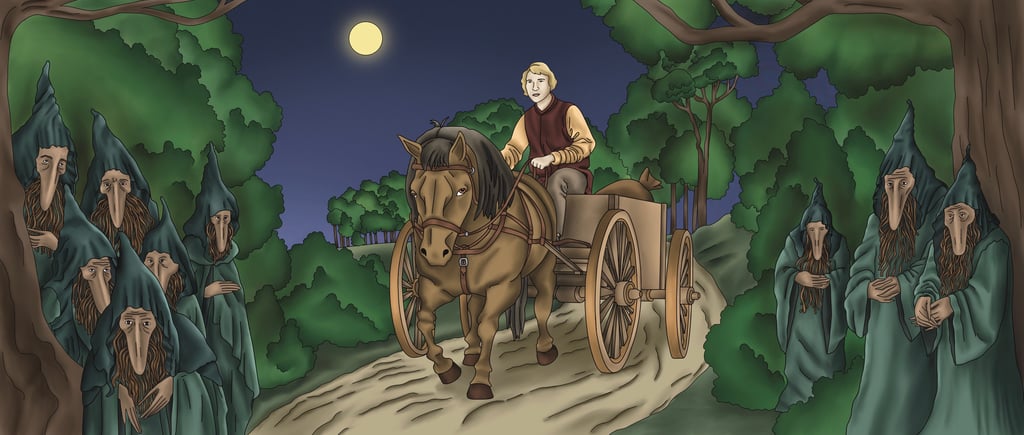
As soon as he uttered that, the dark foresters left him and rushed to hunt for the sharp stones. They were collecting them and quarreling among themselves. A menacing uproar arose, while the elder brother did not waste any time and hurriedly rode away.
“Well done!” the brownie-spirit praised him. “We are almost there. The door of the mill will be locked, and the mermaid of the mill pond keeps the key. Ask her for this key and offer her the flowers.”
The elder brother rode up to a lonely mill. It was an ancient building with walls covered in moss. Right above the roof, the bright full moon was shining. The mill pond was covered with water lilies.
He threw the wildflowers into the water and said politely: “I brought you some special flowers that grow in the fields, oh mill pond maiden, so you can make a pretty wreath to highlight your beauty. Give me the key to the mill!”
He immediately felt an eeriness from the sound of his own voice, since such silence reigned around the enchanted place, and then, he almost fell into the pond, because he was startled by a white hand rising above the surface of the water and depositing a weighty key on a mossy stone nearby.
The elder brother grabbed the key and placed it into the lock. The lock clicked, the door creaked and opened, and he found himself inside the mill. The moonlight decently illuminated its interior. The elder brother brought his bag inside and began to grind the grain. The millstones rustled, the water started to gurgle, the mill wheel groaned, and the voice of the mermaid from the pond sang:
“You worked hard for this fine grain,
You won’t make your trip in vain!”
Then a melodic ringing was heard, as silver coins fell to the floor, glittering like little moons. The mill was grinding the grain into coins. The whole night passed this way, with the rustling of the millstones, the groaning of the mill wheel, and the singing of the mermaid. By dawn, a whole heap of silver coins lay on the floor. All the grain from the bag had been ground and turned into money.
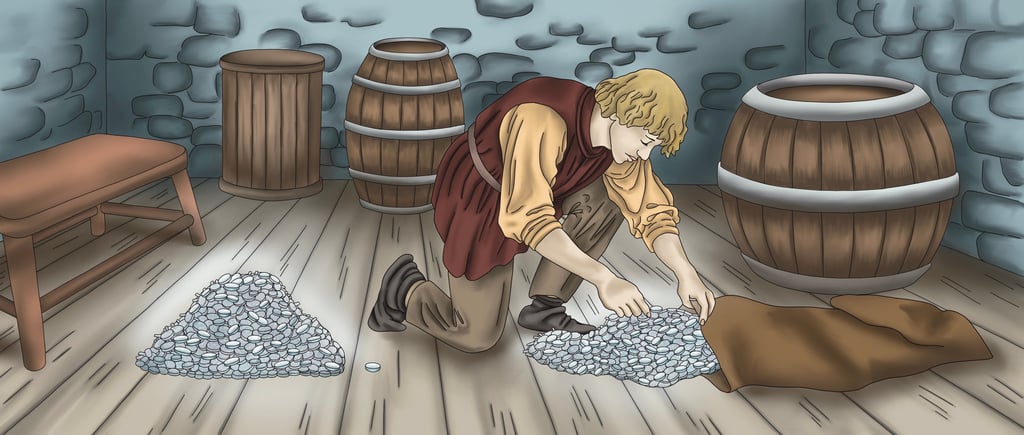
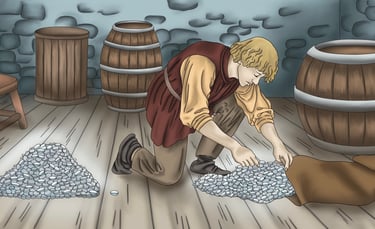
The bag was not even big enough to pack all the silver. The elder brother had to tie some of it into his jacket and place some into his hat. When he was leaving the mill, he involuntarily turned around and saw the door slam shut, the key, which was still sticking out of the lock, clicking and turning by itself, and then flying through the air and plopping into the waters of the pond.
Now, in the morning light, the forest seemed much more welcoming. The elder brother left it without incident. Only when he reached the bog did he see in the thick shadow under a bush, the huddled bog-dwelling spirit woman, who was muttering something.
Seeing the elder brother, the bog woman rushed to him, grabbed the side of his cart with her hands, and growled:
“Tell me the answer to the riddle, otherwise I won’t be able to get any peace now!”
“It’s a bog, my lady,” said the elder brother.
The bog-dwelling spirit woman hit herself on the forehead with the palm of her hand in annoyance and jumped into the greenish muck of the bog, disappearing behind a hummock.
“Are you happy with the wealth you acquired?” asked the voice of the brownie-spirit from the box.
“More than happy!” replied the elder brother.
“Remember, if your younger brother questions you on where you have gotten the money, tell him everything, without hiding a single fact.”
The elder brother returned the horse and cart to the younger one. The latter searched it thoroughly and to his amazement, found two silver coins under the hay that lined the cart.
“So, that’s the kind of grain he was grinding!” the younger brother said to himself and went to his elder sibling to question him.
The elder brother told him all about the mill and the brownie-spirit.
“He was luckier after all,” the younger brother thought angrily. “I have to engage in work when he can grind up some money for himself at
any moment!”
The greedy one thought and thought the whole thing over, and could not resist the temptation. He bought five sacks of grain, loaded them into a cart, and went to the enchanted mill. He deftly avoided all the obstacles on his way: he posed a riddle to the bog woman about the bog, deceived the black foresters with the shiny pebbles, got the key for the mill from the mermaid, and all the time he was not afraid, for he was driven by greed.
But as soon as he began to grind the grain, the millstones started to groan with effort, the water roared menacingly, the mill wheel pounded loudly, and the mermaid’s voice cried out in anger:
“Didn’t work for this fine grain
You will make your trip in vain!”
And then even louder: “You are an impostor! Stop the impostor!”
The doors of the mill slammed shut, the key clicked in the lock, bolting it securely. The younger brother was terrified. He climbed out of the window of the mill, which was right above the pond. Then the mermaid grabbed him by the legs and dragged him to the bottom. That’s how the younger brother perished. But it was he who brought the trouble upon himself.
His horse found its way out of the forest and wandered home with the cart. In the end, all the merchant’s property, which the younger brother had appropriated for himself through trickery, went to his elder brother. All according to the law. As for the elder brother, he had a comfortable life, but he always considered the simple wooden box, in which the brownie-spirit lived, to be the most precious of all the riches he possessed.
(Posted June 1, 2026) © 2025
(Stories to be continued...)
The Tale of The Feud and the Dream
Once upon a time, there lived a baron. For several generations, his family was engaged in a deadly feud. The war of “the Griffin” and “the Wolf”, as it was called, for the baron’s coat of arms carried the Griffin, while the Wolf was baring its teeth on the crest of his foe. Many battles were fought, much blood was shed. The two adversaries were tearing each other to pieces, but neither could get the upper hand.
That was until “the Griffin” started to lose battles. The baron’s opponent became more and more cunning, seemingly anticipating every move of the baron. It was as if he was reading the baron’s very thoughts about his war strategy.
“I am being slowly defeated,” thought the baron. “How disappointed my ancestors, who waged the war successfully and never gave in to the enemy, would have been if they knew of my misfortunes. If another battle is lost, I won’t be able to recover my forces.”
Therefore, the baron hurried along the gallery of the portraits of the Griffin barons of old, without raising his head, afraid to see the silent reproach in their eyes. Once, however, when his reconnaissance detachment was ambushed and destroyed, he approached the oldest darkened portrait of his great-great-great-grandfather.
It was he who built and fortified the castle, the citadel of the Griffin, and began the war with the aggressive Wolf.
“You must be disappointed that your side is losing and the Griffin stronghold could soon fall because your descendant turned out to be a weakling,” said the baron. “It is unimaginably hard for me too!”
The baron raised his head and looked at the portrait. It seemed to him that the eyes on the canvas had come to life for a brief moment, and looked back at him not with contempt, but with warmth and understanding, before fading again.
From that time, the baron began to have the same dream every night. He stood outside the walls of his castle, on a plain covered with freshly fallen snow, while the full moon shone brightly in the night sky. The baron looked at the moon and then lowered his gaze to the snowy expanse spreading out in front of him and saw a chain of prints that had not been there a moment before leading away from the castle towards a quiet hollow nearby.
The dream was so vivid that the baron decided to check it out on the spot. There was only one day left before the decisive battle with the enemy. The baron waited until nightfall, then discreetly slipped out of the castle through a secret passage. Everything was as in his dream. The moon was shining in the sky. A light snow had fallen and covered the plain in front of the castle. The baron looked at the moon, then at the ground and saw a chain of prints in the snow that led from the place where he stood right to the quiet hollow. These were strange prints, they did not belong to either an animal or a human, as if a tree branch had been dragged through the snow.
He reached the quiet hollow and saw a light sparkling in the distance. Finally, the baron came to a hut, crudely made of rough stones. He was surprised, for he did not remember that any dwelling existed in the hollow. The light was coming through the loosely closed shutter of a small window. Also, a soft song began to flow out of the hut. The baron peeked in the window and saw a young woman sitting near a cradle and singing a lullabyto her child. The burning fireplace softly illuminated the room, and on the walls danced intertwining shadows. Listening to the song, the baron involuntarily shuddered.
“Oh, my dear child, go to sleep,
All your sweet dreams I’ll tightly keep,
You won’t be affected by worries and hassle
Like our baron who lives in the castle.
He got a traitor around in his ranks.
Because of this snake, good fortune he lacks.
If he won’t find the spy, he’ll perish in sorrow,
And certainly, lose his combat tomorrow,”
sang the woman.
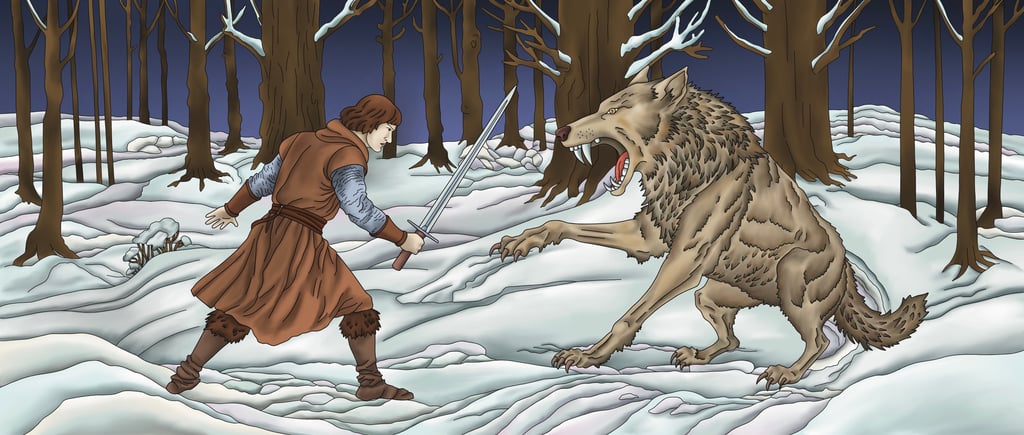
The baron took hold of the door handle and was about to enter the hut when he heard a menacing roar behind him. He turned around and barely had time to draw his sword when a huge, ferocious wolf attacked him. It looked exactly like the beast that adorned the coat of arms of the baron’s opponent. A terrible battle began. The wolf’s claws were sharper than daggers, and his teeth were like sword blades. His eyes burned with a raging fire.
The end would have come for the baron, but his trusty sword helped its master. It pierced the wolf through and through. The wolf snapped its teeth one last time and died, pouring dark blood onto the snow. The door of the hut opened, and the young woman stepped onto its threshold. Her skin was white, as if touched by the frost of winter, her eyes shone like stars in the night sky, and her hair glowed like the moonlight. She did not look human at all, and the baron guessed that she belonged to the Fay People.
“You protected the wife and child of the Master of the Hollow during his absence,” said the young woman. “He will never forget this service. You’ll find the one who betrayed you, oh baron. The weapon of the traitor will turn to ashes when it touches the blade of your sword. Farewell!”
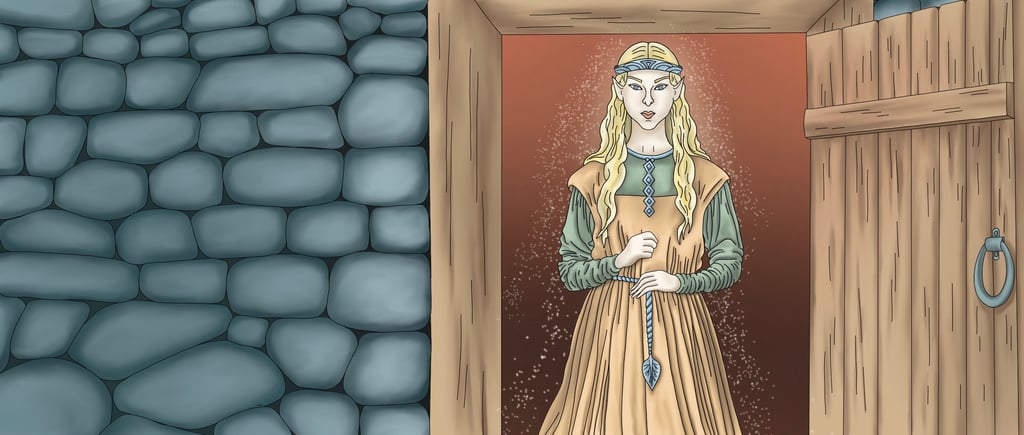
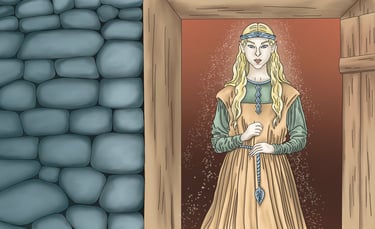
At that very moment a blizzard arose, hiding everything from the baron: the mysterious hut, the woman standing on its threshold, the wolf’s corpse in the snow, and the hollow itself.
The baron closed his eyes for a moment, blinded by the flying snow, and when he opened them again, he found himself in his room in the castle.
“Did I really see all this in a dream?” thought the baron in amazement, but then he saw his clothes torn in the fight with the wolf. His breastplate, as he was wearing some protective armor, was bent and bore scratches from the blow of a paw with sharp claws. The baron grabbed his sword. There were no traces of wolf’s blood on the blade, but red sparks shone in the steel of the faithful weapon as if they were soldered there.
The baron jumped up and hurried into the castle courtyard, called his squad, and ordered the fires to be lit.
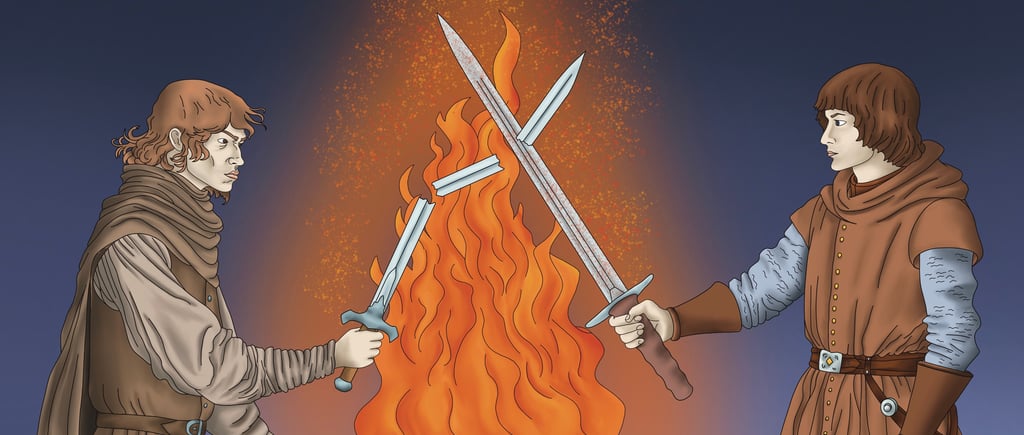
The baron told his men to prepare for battle. He then he ordered everyone to swear an oath of allegiance to him once again, for the coming combat would be a decisive one and he needed truly loyal people by his side. He drew his sword and said that each warrior under his command should touch its blade with the blade of their own weapon.
All his men did so willingly. Their blades rang out loudly, striking their leader’s blade, while everyone repeated the words of the oath. However, only one blade did not ring out loudly but shattered into pieces. It was the blade of the one warrior the baron would never have suspected, the one who was supposed to command the reserve ambush regiment.
Thus, the baron found and executed the traitor and then triumphed as the winner of the battle in which he slew his opponent, the one who wore the ferocious wolf on his coat of arms. The feud was over.
“The Griffin tore the Wolf’s throat and remained the winner. Who would have thought!” the neighbors said in the aftermath, “we were sure that the Wolf would bite the Griffin in half, but look how it all turned out!”
Since then, the baron was not threatened by any betrayal. As soon as a person swearing allegiance to him was taking the oath and touching the baron’s sword with his blade, his secret intentions became clear as day. It was no longer possible to deceive the baron.
And he was also grateful to his ancestor. He was sure that the matter could not have been resolved without his help. He addressed his great-great-great-grandfather in the portrait gallery many times, but the eyes of the portrait always remained dim. Probably, the founder of the castle decided that the real danger that threatened his family line had passed, and the present baron no longer needed his assistance to deal with everyday life from now on.
(Posted May 1, 2026) © 2025